Home Products
All formats
Custom About Us Contact Us Blog info@qicaipress.com Get a Quote

Products — Bible & Liturgical

Scripture, sewn to last generations.

Bible & liturgical book printing on 28–40gsm thin paper — Smyth sewn book blocks that open flat through decades of daily use, finished with gilded edges, ribbon markers and covers from PU leather to goatskin. Factory-direct from Guangzhou since 1995.

28–40gsmHigh-opacity Bible paper
Smyth SewnLies flat at 180°
1–8 RibbonsText to altar editions
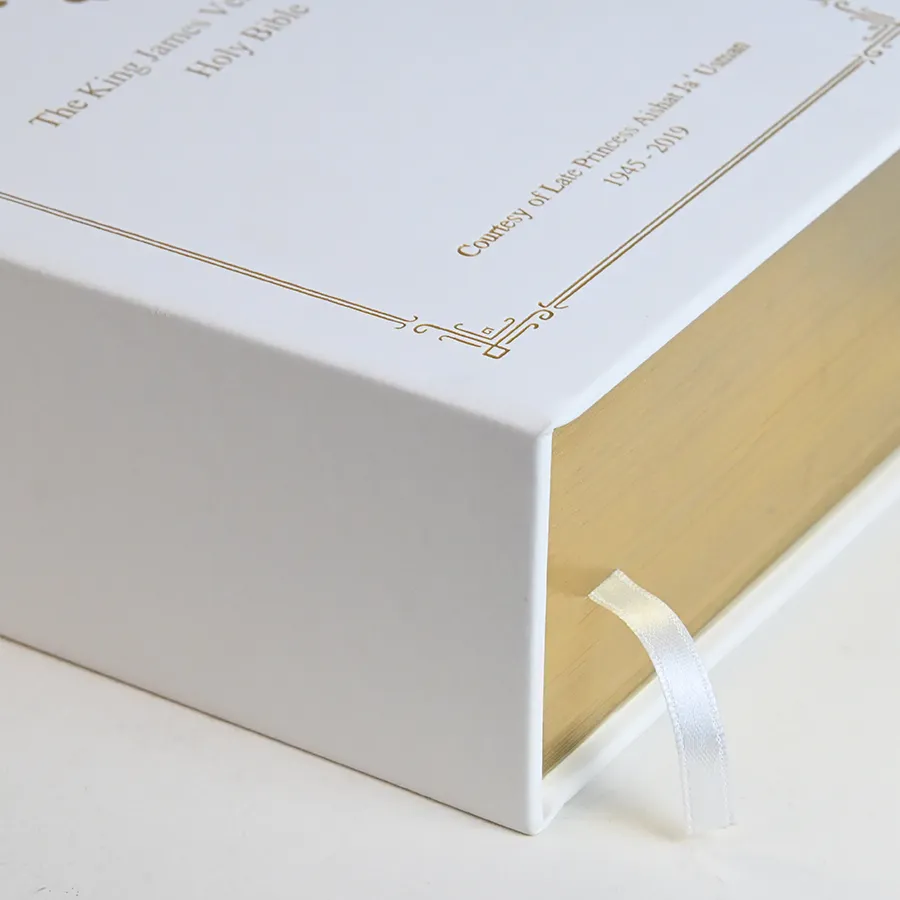
White KJV gift Bible with gold foil frame, gilded edges and satin ribbon marker, in presentation box
22–50gsmBible paper range
2,500ppMax sewn book block
2-ColorRed-letter & rubrication
3–5 DaysPhysical proofing
15–25 DaysProduction & packing
What we print

One bindery, the whole liturgical shelf.

The same thin-paper, sewn-binding craft carries every format — from a pew Bible to an eight-ribbon altar missal. Select a category to see it.

The craft

Details only Bible printers keep.

A Bible is the hardest book in the trade: the thinnest paper, the thickest block, the longest life. These are the techniques that make it possible.

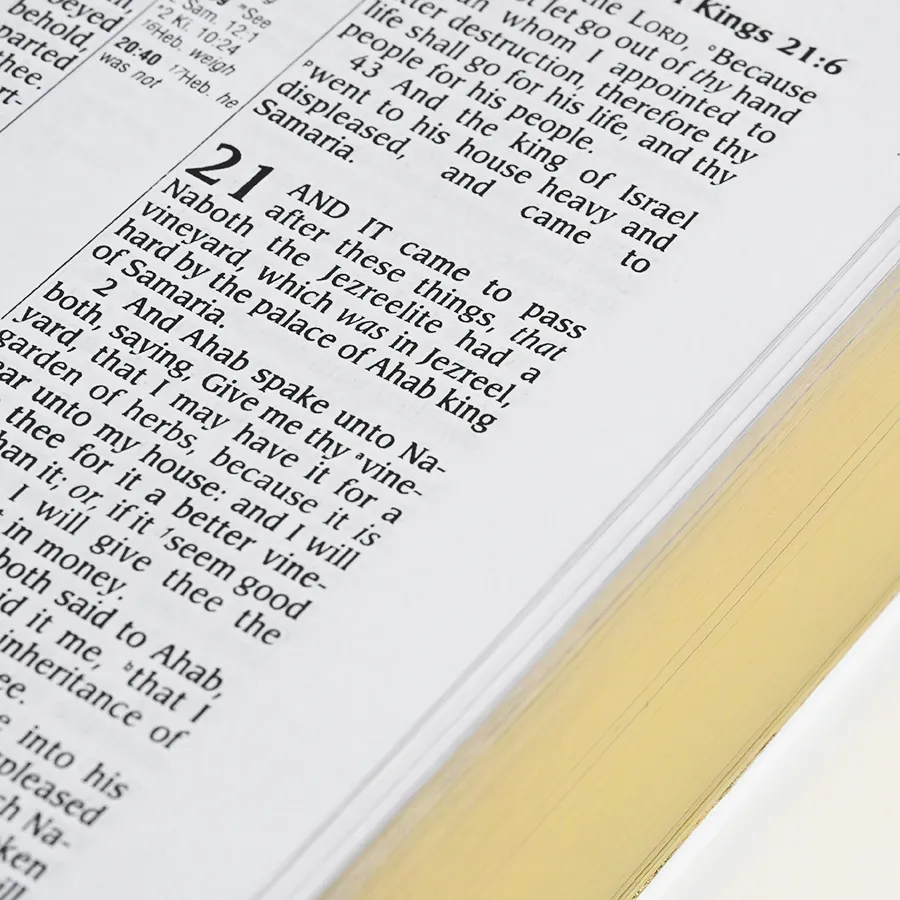
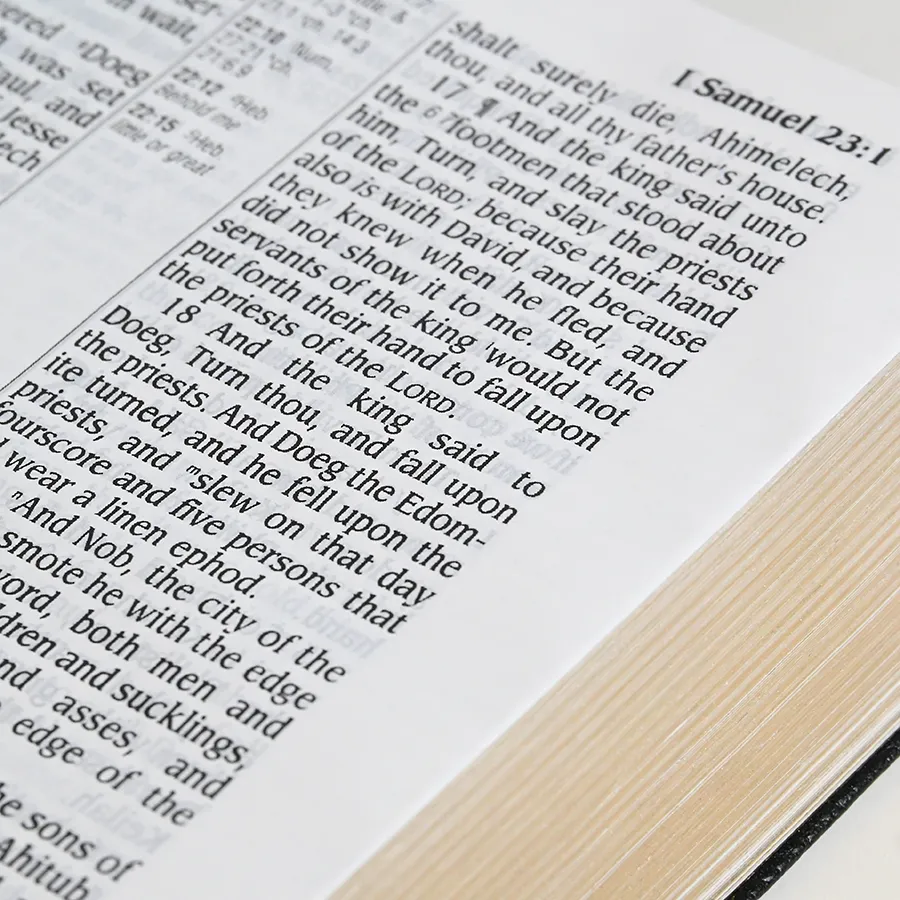
Close-up of KJV Bible page on thin high-opacity paper
Bible paper, 28–40gsmNo show-through
Gilded page edges on a sewn Bible book block
Edge gildingGold · silver · art-gilt
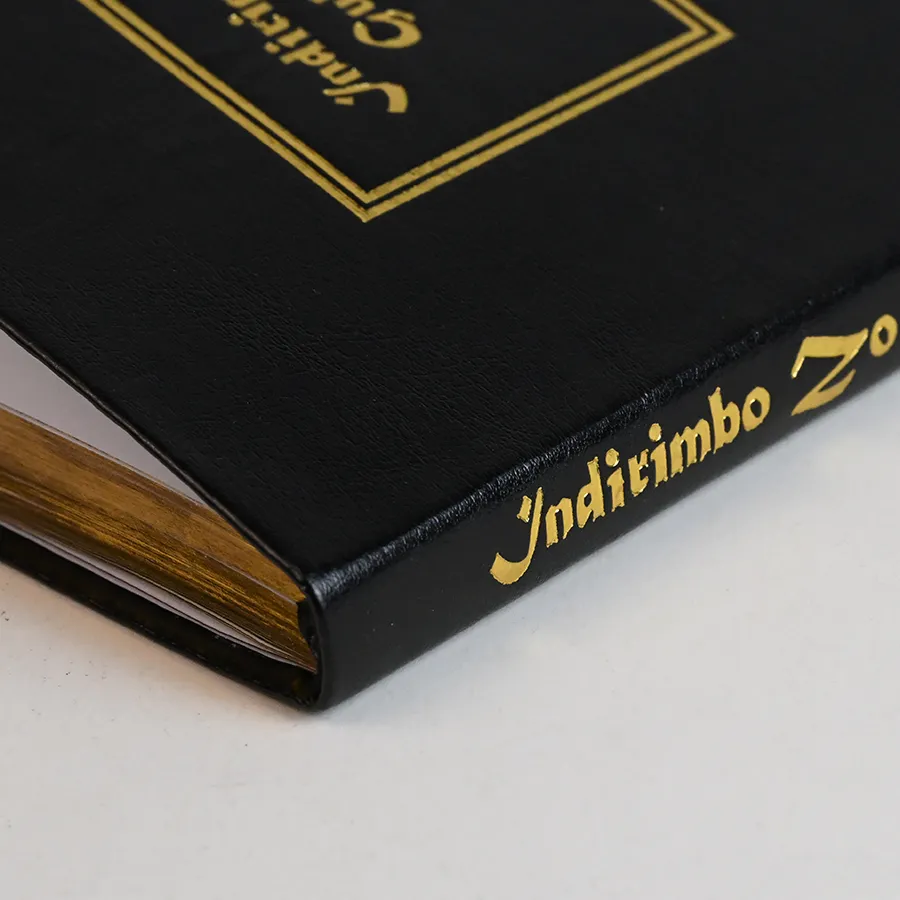
Black PU leather cover with gold foil stamping and art-gilt edges
Foil on PU leatherSpine & cover stamping
01

Bible paper

28–40gsm standard, down to 22gsm ultra-thin and up to 50gsm for study editions — high opacity so 2,000+ pages stay legible and portable.

02

Smyth sewn binding

Signatures sewn through the fold, section by section. The block opens flat at 180° and survives decades of daily use without shedding pages.

03

Cover materials

PU leather for gift editions, genuine leather and goatskin for heirloom work — with rounded corners and flexible or rigid boards.

04

Gilded edges

Gold, silver or red-gold page edges; art-gilt (red under gold) available for premium editions.

05

Ribbon markers

One to three ribbons on trade editions; four to eight on liturgical books, anchored into the spine lining, not glued to the endpaper.

06

Red-letter & rubrication

Two-color text printing with tight register: red-letter words of Christ, or red rubrics against black text for missals and service books.

07

Thumb indexing

Die-cut half-moon tabs with book names on the fore-edge — instant navigation across 66 or 73 books.

08

Yapp edges

Soft covers overhanging the block by 6–12mm to shield gilded edges — with round-cornering to keep thin paper from dog-earing.

Rights & compliance

Your text, printed exactly. Nothing else.

We are a printer, not a publisher. Modern translations remain the property of their rights holders, and approved liturgical texts may not be altered by anyone — least of all the factory. That is not a limitation we work around; it is the standard we work to.

Publishing houses ask about this before they ask about price. Here is our answer, in writing.

License verification

For copyrighted translations we print only against your authorization from the rights holder — covering territory, language and print run — before a plate is made.

Approved texts, untouched

Liturgical files are reproduced exactly as approved — spelling, punctuation, pagination and rubrics. We flag anomalies to you; we never correct them ourselves.

Public-domain guidance

KJV and Douay-Rheims texts are in the U.S. public domain — the legitimate route for redesigned and personalized editions. We help you keep new artwork and notes on the right side of the line.

Controlled waste destruction

Overs, misprints and make-ready sheets are pulped under supervision. Licensed text never leaves the factory in any form you did not order.

Questions

Before you ask for a price.

The answers buyers usually need first — rights, canon, and what a sample costs you (nothing).

Bible paper, explained

Smyth sewn vs perfect binding

How to choose book paper

Do I need a license to print my Bible edition?

For modern translations (NIV, ESV, NKJV, NLT and others) — yes. You bring the text and written permission from the rights holder; we verify it before production. KJV and Douay-Rheims are public domain in the U.S., so redesigned editions of those texts need no license. Selling KJV editions in the UK involves Crown letters patent — worth checking with your legal counsel for that market.

Why does the quote ask which canon I need?

A Protestant Bible has 66 books; a Catholic Bible has 73 (including the deuterocanon); Orthodox canons run 78 or more. That difference changes page count, paper volume, spine width — and therefore price. It is the first spec we confirm.

What is the difference between red-letter and rubrication?

Red-letter editions print the words of Christ in red within a standard Bible. Rubrication is a liturgical convention: black for spoken text, red for instructions — the heart of missals and service books. Both are true two-color text printing with tight register on thin paper, not a digital tint.

Can you reproduce our approved liturgical layout?

Yes — exactly, and only exactly. Lectionaries and missals are printed from your approved files with pagination, responses and rubrics untouched. We do not re-typeset or "improve" approved texts.

What is the minimum order?

Typically from 500 copies for Smyth sewn thin-paper editions, where make-ready costs are meaningful; simpler formats such as prayer booklets start lower. Tell us your quantity — we will tell you honestly where the pricing tiers fall.

How do I check quality before committing?

Ask for a paper dummy or a physical pre-production sample — 3–5 days. Open it flat, hold a page against the light, count the show-through. That test is exactly why we insist on sending one.
Tell us about your edition.

Version and canon, page count, paper weight, cover and quantity — or just what you know so far. A factory quote comes back within 24 hours.

info@qicaipress.com

Files and rights documentation are handled in confidence.